The Hidden Cost of Non-Stick: What You Pay Every 18 Months
A non-stick pan costs ₹800. A brass handi costs ₹2,400. On first glance, the choice seems obvious. Run the numbers over a decade — and the picture reverses entirely.
This is not a polemic against non-stick cookware. It is an honest accounting: what you pay, what you get, and what you trade away. Most cookware marketing talks only about the purchase price. We think you deserve to know the full cost.
The Replacement Cycle
Non-stick coatings — whether PTFE (Teflon), ceramic, or marble-pattern — have one thing in common: they degrade. The coating is the product, and the coating wears out.
Under normal household use, a non-stick pan needs replacement every 12–24 months. Cooking schools and professional kitchens replace them every 6–12 months. Scratches, chips, and browning are the visible signs. The invisible ones are harder to track.
The 10-Year Cost Calculation
Non-stick pan (₹800) × 6 replacements over 10 years = ₹4,800
Ceramic-coated pan (₹1,800) × 4 replacements = ₹7,200
Stainless steel cookware set (₹4,500) × 1–2 replacements = ₹6,750
Brass handi, pure copper pot, or kansa vessel: ₹2,400 — bought once. Never replaced. Resale value at metal rate.
The numbers favour pure metal from year three onward. But the financial comparison is only one dimension.
The Coating Question
PTFE (polytetrafluoroethylene), marketed under the name Teflon, has been the dominant non-stick coating since the 1960s. Its safety profile is nuanced and worth understanding.
At normal cooking temperatures (below 250°C), PTFE is considered chemically inert by food safety regulators. The concern arises at higher temperatures and with mechanical damage. When a non-stick surface is scratched, the coating begins to flake. When overheated past 300°C — which can happen quickly on a high gas flame — PTFE degrades and releases fumes that are toxic to birds and, at sufficient exposure, harmful to humans.
The more significant ongoing concern involves PFAS (per- and polyfluoroalkyl substances), the class of chemicals used in manufacturing non-stick coatings. PFAS are known as "forever chemicals" because they do not break down in the environment or in the human body. Certain PFAS compounds — including PFOA, which was phased out by major manufacturers in 2013 — have been linked to thyroid disruption, immune function changes, and increased cancer risk at high exposure levels.
"PFAS can be found in the blood of people and animals all over the world and are present at low levels in a variety of food products and in the environment." — US Environmental Protection Agency
Modern non-stick pans claim to be PFOA-free. Many still use PTFE and related PFAS compounds. The science is evolving. What is already certain is this: pure brass, copper, and kansa contain no coatings at all. There is nothing to flake, nothing to degrade, and no PFAS to enter the food chain.
The Comparison at a Glance
| Factor | Non-Stick | Stainless Steel | Pure Brass / Copper |
|---|---|---|---|
| Upfront cost | Low (₹600–2,500) | Medium (₹1,500–6,000) | Medium (₹1,200–5,000) |
| 10-year cost | High (multiple replacements) | Medium (1–2 replacements) | Low (never replaced) |
| Lifespan | 1–3 years | 5–15 years | Indefinite |
| Coating safety | PTFE / PFAS concerns | None (uncoated) | None (pure metal) |
| Heat retention | Poor | Moderate | Excellent |
| Heat distribution | Moderate | Moderate | Excellent (esp. copper) |
| Flavour impact | Neutral to flat | Neutral | Warm, rounded depth |
| Environmental impact | High (PFAS, landfill) | Moderate | Low (recyclable, no coatings) |
| Resale / scrap value | None | Low | Metal market rate (buyback) |
| Dishwasher safe | Often yes (degrades faster) | Yes | No (hand wash only) |
What Non-Stick Does Well
Fairness requires acknowledging where non-stick cookware genuinely excels. For eggs, crêpes, and delicate fish, a non-stick surface performs in ways that brass or copper cannot match without considerable technique. The easy release and quick cleanup are real advantages.
The point is not that non-stick cookware is useless. The point is that it should not be your primary cookware — and that for the slow cooking, simmering, and serving that defines Indian kitchen work, pure metal is simply better at the job.
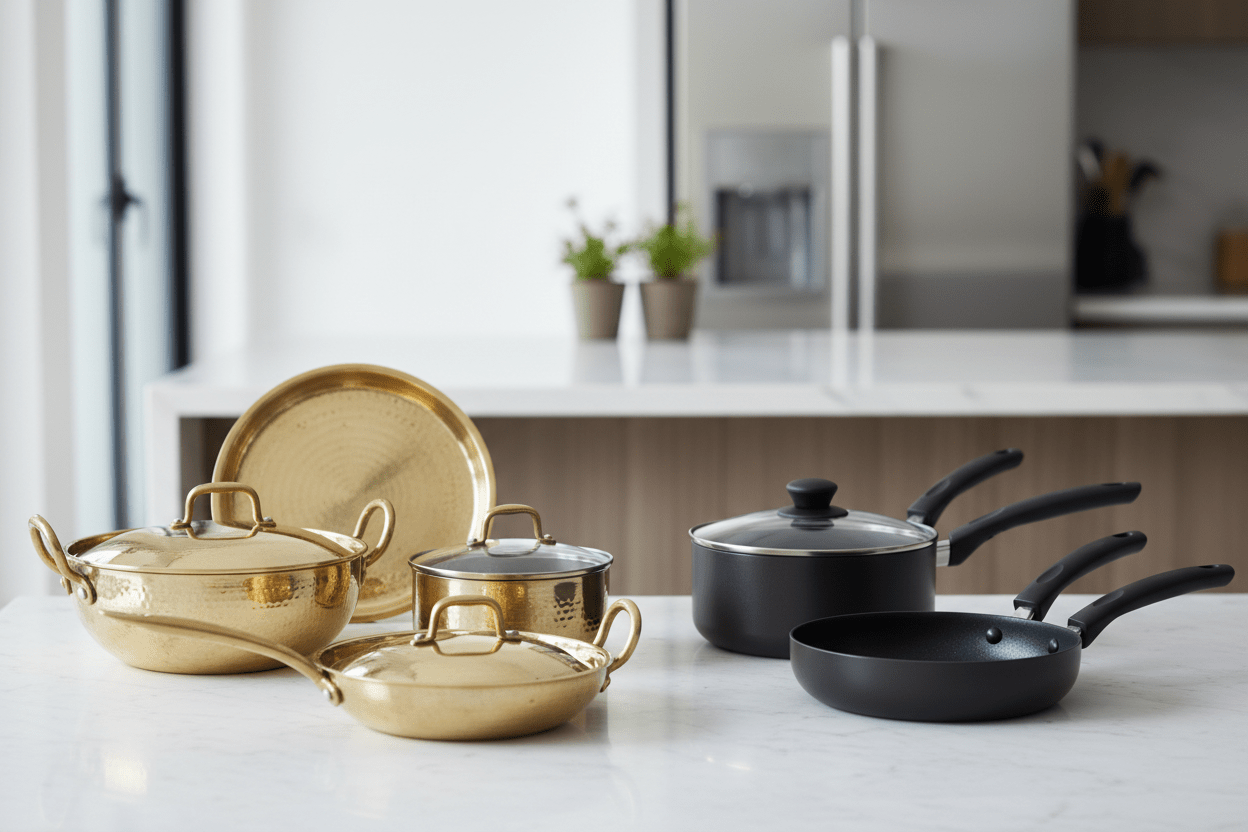
A practical approach used in many Indian households Keep one non-stick pan for eggs and flatbreads. Replace everything else — dal pots, serving dishes, rice vessels, water containers — with pure brass, copper, or kansa. The best of both worlds, with the health and durability of metal where it matters most.
The Environmental Argument
Each discarded non-stick pan carries its coating chemistry to landfill, where PFAS compounds leach into groundwater over decades. An estimated 800 million non-stick pans are discarded globally each year.
A brass vessel, by contrast, is infinitely recyclable. When it reaches end of life — which for a well-made piece is measured in generations, not years — the metal is recovered and reused. At House of Dhatu, we offer a buyback programme at the current live metal rate, precisely because the metal in your vessel holds its value indefinitely. It is, as we put it, the only cookware your jeweller would understand.
What to Look For If You Are Switching
Not all brass and copper cookware is equal. Some products are electroplated steel with a thin brass finish — they look right but are not pure metal. Others are coated internally with synthetic lacquers that defeat the purpose.
When buying pure metal cookware, look for: NABL certification (India's standard for verified metal composition), uncoated interior surfaces, and a manufacturer willing to state the exact metal composition. At House of Dhatu, every product comes with a composition certificate. Browse our full range →
The switch does require a small adjustment in how you cook — lower flames, more patience, a different cleaning routine. Most people who make the switch say within a month that they would not go back. The food tastes different. Better. And the pan is still there twenty years later.